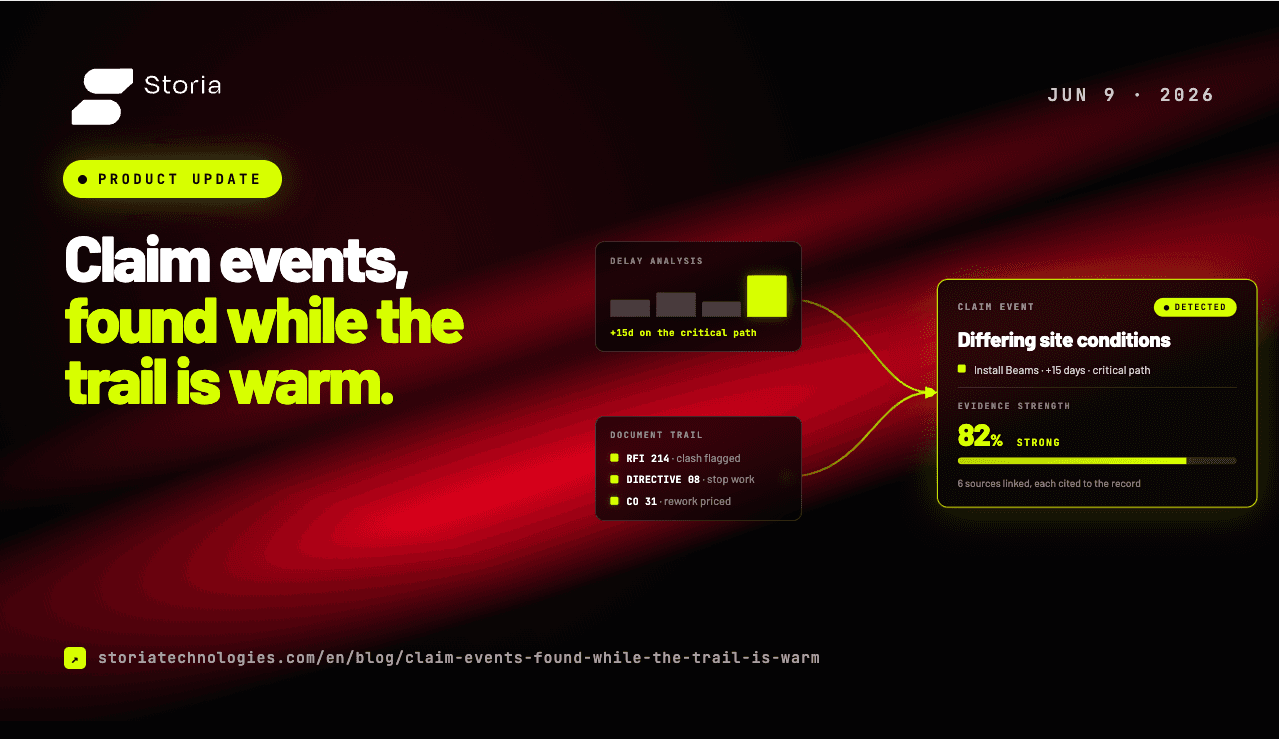
Storia can now find your claim events for you. The new Claim module reads each schedule update, links the document trail behind every slip, and drafts a claim event with its evidence already attached and scored.
This matters because most claimable events are never claimed. Not because they were weak, but because no one noticed they happened while the trail was still warm. By the time a claim is due, the moment that mattered is months gone, and reconstructing it from a cold record is the part that breaks people.
The module changes when the finding happens: while the work is live, not as a forensic exercise at the end of the job.
It finds the events while the trail is still warm
Finding a claim event takes two searches, run against two different parts of the record.
The first is the schedule. A windowed delay analysis compares each update against the prior one and surfaces the activities that moved, by how much, and whether the slip landed on the critical path or burned float.
A schedule slip is not a claim event. It is a question: what moved this, and can you prove it.
The second search runs against the paper trail: the RFI that flagged the clash, the directive that ordered the stop, the change order that priced the rework. The module connects each slip to the documents that explain it, work that used to mean reading across systems and matching dates by hand.
A found event is a cause, an effect, and the proof of both
Take one event from a real project. Install Beams finished sixteen days late. On its own, that is a number on a Gantt chart. Traced, it becomes a claim: a stop-work directive halted beam installation across two zones over an unresolved clash, a later RFI forced a six-inch clearance change that meant rerouting mechanical work, and a change order priced the rework at CAD 263,700. Cause, effect, and the documents that prove each link, every one cited to its source.
Every event arrives with an evidence strength score
What the evidence strength score weighs
The evidence strength score weighs three things: whether the contract gives you entitlement, whether the slip is material to the critical path, and how completely the record backs the story. A dated directive, a costed change order, and a clear RFI score higher than a slip you can only explain from memory.
The score is attached at the point of discovery, so the weak events sort themselves from the strong ones before you commit time to building anything.
What you can do with it now
Open any schedule update and the critical-path slips are already surfaced. Click one and the claim event is drafted for you: evidence linked, cited, and scored. The work that took an afternoon per event now happens as the update lands.
That is the whole shift. Events used to be reconstructed at claim time, from a box of documents and whatever people remembered. Now they are found as the work happens, already linked to their cause.
From there the same event carries forward without re-discovery, into a claim package if you are building one, or into a dispute if the entitlement is contested.
The event you find while the trail is warm is the one you can still prove.
Guillaume Ah-ki is the full-stack lead at Storia. Reach out at info@storiatechnologies.com if you want to see the Claim module run against your own schedule updates.