Construction projects do not fail to produce information. They produce too much of it, scattered across RFIs, meeting minutes, directives, change requests, change orders, schedules, submittals, drawings, correspondence, and field updates. Each record captures only part of what happened.
The same issue may appear across several documents with different wording, owners, dates, and levels of detail. The hard part is not finding another document. It is understanding which records refer to the same issue, what changed, who was involved, what was affected, and which documents prove it. That is where a construction knowledge graph becomes useful, but only if it is built with discipline.
A graph created from extraction alone can look intelligent while quietly connecting the wrong records. A trusted construction knowledge graph needs more than names, documents, and links. It needs evidence, validation, deduplication, provenance, and rules that understand how construction records actually work.
A graph connects records into project context
Keyword search can help teams find documents that contain matching words. But construction issues rarely live in one document. A coordination problem may start in an RFI, appear again in a meeting minute, become an instruction in a directive, and later surface as a change request with cost or schedule exposure.
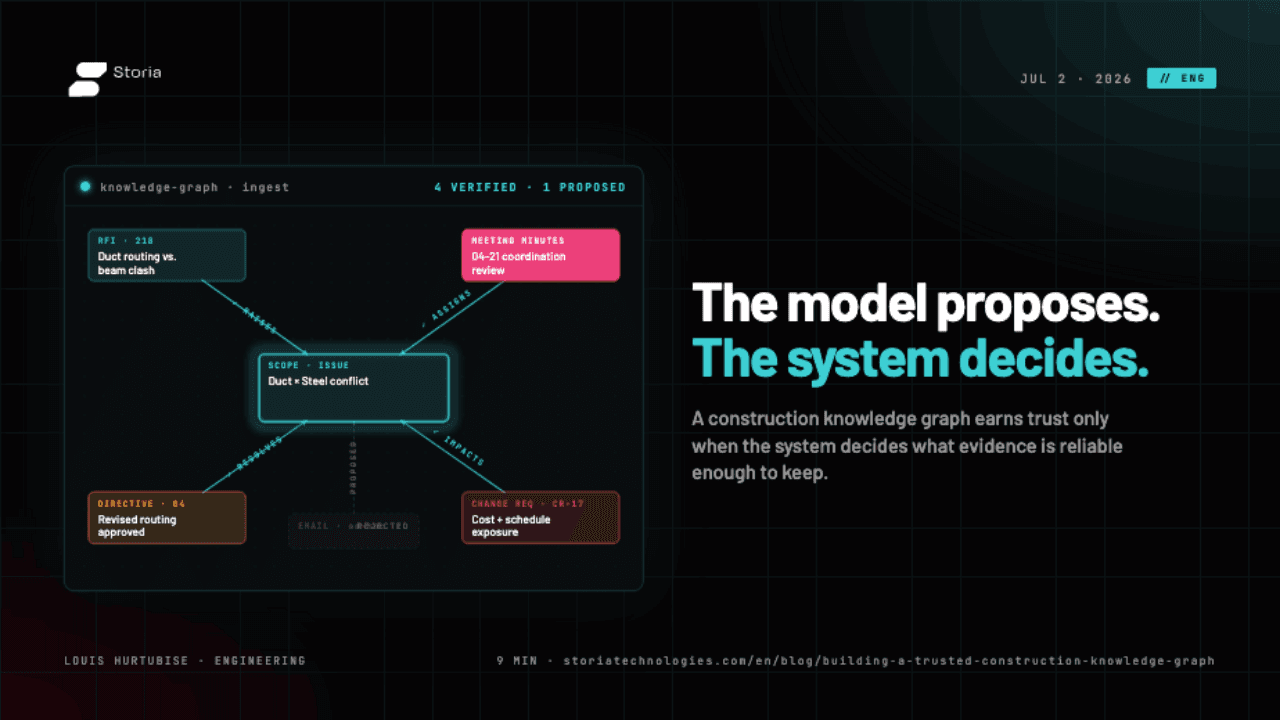
One issue, four records
- An RFI asks whether a mechanical duct route conflicts with structural steel.
- A meeting minute assigns the coordination issue to a subcontractor.
- A directive instructs a revised routing approach.
- A change request captures the resulting cost or schedule impact.
Individually, each record is useful. Connected together, they explain the project story. That is the value of a construction knowledge graph: not just finding documents, but understanding how documents, people, companies, locations, systems, decisions, issues, and impacts relate to each other across the project record.
At Storia, we build knowledge graphs to make project information more connected, explainable, and useful. But the goal is not to create as many connections as possible. The goal is to preserve the connections that are supported by evidence and useful to the project team.
Why extraction alone is not enough
It is tempting to ask AI to read the documents and build the graph by itself. Give the system a construction document and ask it to identify the people, companies, locations, systems, activities, impacts, and dependencies it finds. It returns names, issues, and possible links between them. In a prototype, this can look impressive.
But production systems do not usually fail because AI misses everything. They fail because some outputs are plausible, inconsistent, duplicated, or difficult to verify. Construction data is full of ambiguity. The same location may appear as Level 08, L8, Floor 8, or Level 8. A company may be referenced by its legal name in one document and by a shorthand name in another. If these cases are handled only by an AI prompt, the graph becomes unstable.
The symptoms are easy to recognise
- Duplicate records for the same issue, company, location, or scope item.
- Inconsistent labels for similar connections.
- Plausible details that are not supported by the source document.
- Different graph structures across repeated runs.
- Links that are difficult to explain when users ask where the connection came from.
These problems are not cosmetic. If one mechanical coordination issue becomes five separate records, search gets worse, impact analysis gets weaker, and users lose confidence. If a link is plausible but unsupported, the graph starts to look intelligent while becoming less reliable. Understanding construction language and creating trusted context are related problems. They are not the same problem.
The model proposes. The system decides.
Storia treats AI output as proposed knowledge, not accepted truth. AI helps interpret messy construction records. It can identify candidate documents, organisations, people, locations, systems, scope items, dependencies, decisions, risks, and possible impacts, then extract supporting evidence from the source material.
The model proposes
What a document may be saying
AI reads messy records and suggests entities, relationships, and evidence: candidates, not conclusions.
The system decides
What is reliable enough to keep
A governed layer validates every candidate against evidence, identity, duplication, and document type before it enters the graph.
Before something becomes part of the knowledge graph, the surrounding system has to answer stricter questions:
This distinction matters. AI proposes what a document may be saying. The system decides what is reliable enough to keep. A reliable graph should not connect every document that mentions ducts, steel, coordination, or cost. It should treat those records as possible parts of the same issue, then validate the connection against evidence, document type, dates, and project context.
Trust requires restraint
A good knowledge graph is not the graph with the most records or the most links. It is the graph where users can trust what the connections mean. That requires restraint. Not every name, location, or issue mentioned in a document should become part of the graph. Some outputs should become nodes. Some should remain candidates. Some should be attached only as supporting evidence. Some should be discarded.
Without these checks, the graph may connect documents that are merely similar. With these checks, it can surface relationships that are useful, explainable, and defensible.
A trusted graph does not create a fictional story because two documents sound similar. It helps teams find the real project story faster.
Different construction documents need different rules
Not every construction record should create the same kind of graph connection. An RFI behaves differently from a change order. A meeting minute behaves differently from a schedule task. A directive may establish an instruction, while correspondence may only clarify or support it.
Some documents are primary records of a decision. Others are supporting evidence. Some can create a direct connection. Others should only increase confidence in a connection already supported elsewhere. Making these distinctions explicit keeps the graph easier to test, easier to explain, and easier to extend as more document types, integrations, and workflows are added. Reliable context comes from understanding not just what a document says, but what role it plays in the project record.
What reliable project knowledge unlocks
Reliable project context gives teams more than better search. It helps them trace RFIs to downstream cost or schedule exposure, connect change requests tied to the same underlying scope, and show which systems, locations, organisations, or work packages are repeatedly affected. For project teams, that means:
- Fewer manual document hunts.
- Faster issue investigation.
- Stronger support for cost, schedule, and scope decisions.
- Better visibility into recurring risks.
- More explainable answers grounded in the project record.
The useful middle ground is important. If related records remain disconnected, teams keep doing the work manually. If weak or duplicated links flood the graph, users stop trusting the system. A valuable construction knowledge graph connects enough evidence to reveal the project story while preserving enough discipline to keep that story grounded.
From fluent answers to traceable answers
Construction teams do not need answers that merely sound right. They need answers that can be traced back to the project record. That requires consistent names for the same people, companies, places, systems, and issues. It requires validation, deduplication, provenance, and evidence grounded in the source records. It also requires rules that respect the differences between RFIs, meeting minutes, directives, change requests, change orders, schedules, and correspondence.
At Storia, AI helps interpret construction language. Governed systems decide what becomes reliable graph knowledge. That is how a knowledge graph becomes more than a search layer; it becomes trusted infrastructure for understanding what happened on a project, why it happened, who was involved, what was affected, and which documents prove it.