Corfu, Greece · 12 to 15 July 2026 · Session: Artificial Intelligence in AEC
Mapeo semántico de solicitud de información (RFI) a elementos BIM con modelos de lenguaje grandes
Limon Paul Joy1, Farzaneh Zarei, PhD1, Prof. Mazdak Nik-Bakht, PhD, PEng1
1Gina Cody School of Engineering and Computer Science, Concordia University, Montréal, Canada
Abstract
Las solicitudes de información (RFIs) siguen siendo un componente crítico pero poco integrado de los flujos de trabajo de construcción, generalmente administrados como texto no estructurado desconectado de los datos del Modelado de información de construcción (BIM). Los estudios existentes se centran principalmente en reducir la frecuencia o el tiempo de respuesta de RFI, con un enfoque limitado en vincular el contenido de RFI a elementos BIM específicos. Este estudio presenta un marco basado en datos que combina la extracción de intenciones basada en un modelo de lenguaje grande (LLM) con el razonamiento de metadatos BIM a través de un proceso de comparación por etapas. Al separar la extracción de señales semánticas de la selección de elementos basada en reglas, el marco mejora la interpretabilidad y la solidez. La validación de conjuntos de datos experimentales y del mundo real demuestra una recuperación confiable de elementos y a nivel familiar.
Keywords: Grandes modelos de lenguaje, Modelado de información de construcción, Solicitud de información, Automatización en la construcción.
1Introduction
A request for information (RFI) is a formal question about an element the writer assumes the reader can identify: a door, a parapet, a window type on a given level. The building information model (BIM) holds that element as a typed record, yet nothing in the project data connects the two. Answering an RFI therefore means searching drawings and specifications by hand; an estimate cited in the paper puts this at 17 person-hours per RFI, with RFI-related delays accounting for up to 10% of project duration.
2Framework
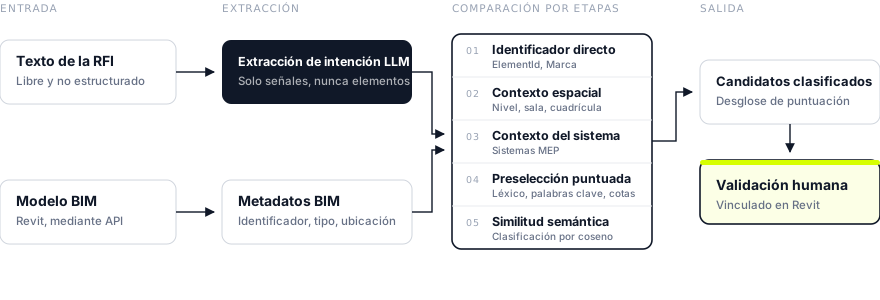
The prototype is a Revit add-in bridged to a Python service. A large language model reads each RFI and returns a strictly formatted set of intent cues: discipline, primary object, keywords, spatial references and dimensions. It is not permitted to name BIM identifiers, Revit categories or element instances.
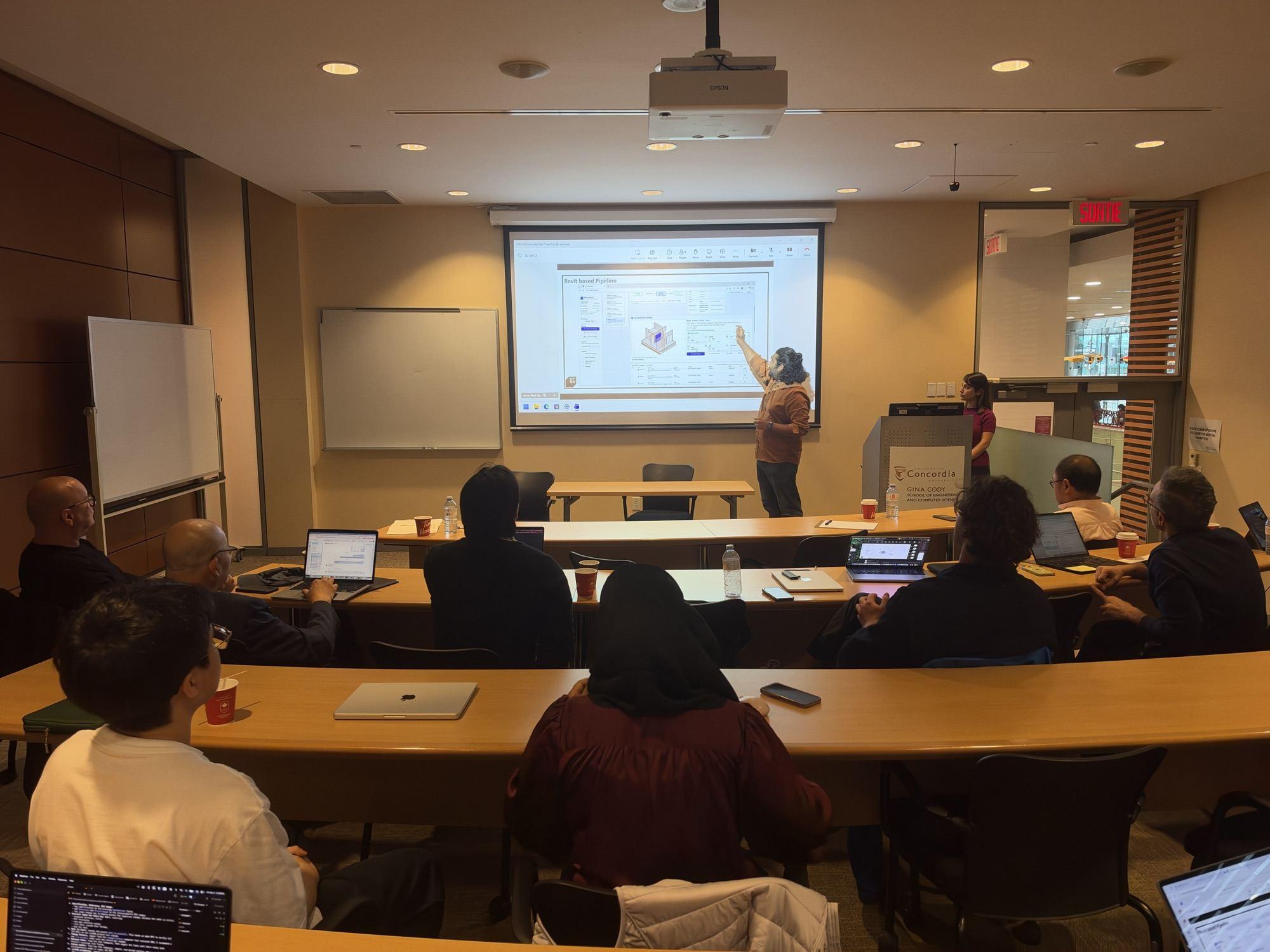
Selection then runs through five ordered stages against the model's own metadata, each contributing an interpretable score: direct identifier, spatial context, system context, a lexical prescore and embedding similarity. A person confirms the result before the link is written back (Figure 1).
3Validation
On an experimental model, 8 of 10 RFIs were linked to the correct element at top-1, and 90% including family or category matches. On a real project, 74 of 524 issued RFIs carried enough text to attempt a link. Accuracy with GPT-4.1 was 60.27% with and without intent extraction.
4Discussion
Performance was driven primarily by the rule-based matching and the quality of the BIM metadata. Failures came from RFIs referring to rooms without instance-level room associations, and from context held in marked-up drawing attachments rather than in the RFI text.