
Aller au contenu principal

Confidentialité

À propos des témoins

Les témoins essentiels font fonctionner ce site. Les témoins d’analyse facultatifs nous aident à comprendre ce qui fonctionne, activés seulement si vous acceptez.

RECHERCHE

EC3 2026 · Corfou, Grèce

Cartographie sémantique des demandes d’information (QRT) vers les éléments BIM à l’aide de grands modèles de langage

Limon Paul Joy, Farzaneh Zarei, PhD and Prof. Mazdak Nik-Bakht, PhD, PEng

  • Liaison sémantique
  • IA interprétable
Conférence
EC3 2026 · Corfou
Session
AI in AEC
Date
12 juillet 2026
Proceedings of the 2026 European Conference on Computing in Construction (EC3)DOI 10.35490/EC3.2026.337

Corfu, Greece · 12 to 15 July 2026 · Session: Artificial Intelligence in AEC

Cartographie sémantique des demandes d’information (QRT) vers les éléments BIM à l’aide de grands modèles de langage

Limon Paul Joy1, Farzaneh Zarei, PhD1, Prof. Mazdak Nik-Bakht, PhD, PEng1

1Gina Cody School of Engineering and Computer Science, Concordia University, Montréal, Canada

Abstract

Les demandes d’information (QRT) demeurent une composante essentielle mais mal intégrée des flux de travail de la construction, généralement gérées comme du texte non structuré, déconnecté des données de modélisation des données du bâtiment (BIM). Les études existantes portent surtout sur la réduction de la fréquence des QRT ou du temps de réponse, et s’attardent peu au rattachement du contenu des QRT à des éléments BIM précis. Cette étude présente un cadre fondé sur les données qui combine l’extraction d’intention par grand modèle de langage (LLM) et le raisonnement sur les métadonnées BIM au moyen d’un pipeline d’appariement par étapes. En séparant l’extraction des indices sémantiques de la sélection d’éléments fondée sur des règles, le cadre améliore l’interprétabilité et la robustesse. La validation sur des jeux de données expérimentaux et réels démontre une récupération fiable au niveau de l’élément et de la famille.

Keywords: Grands modèles de langage, Modélisation des données du bâtiment, Demande d’information, Automatisation dans la construction
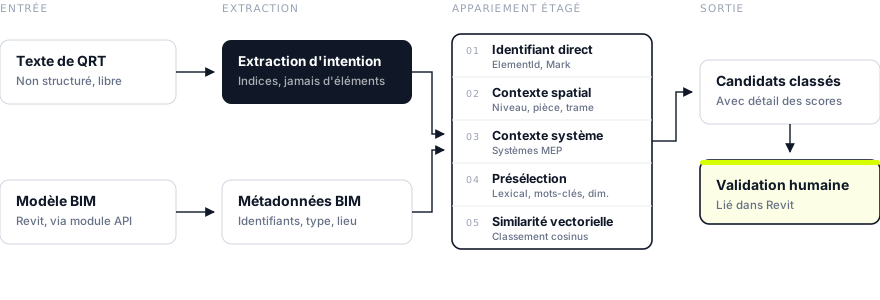
Figure 1: RFI text and the BIM model run through LLM intent extraction and BIM metadata extraction into five ordered matching stages; ranked candidates are confirmed by a person before the element is linked.
Figure 1. Prototype architecture. The language model extracts intent cues only; five ordered rule stages select the element, and a person confirms the link.

1Introduction

A request for information (RFI) is a formal question about an element the writer assumes the reader can identify: a door, a parapet, a window type on a given level. The building information model (BIM) holds that element as a typed record, yet nothing in the project data connects the two. Answering an RFI therefore means searching drawings and specifications by hand; an estimate cited in the paper puts this at 17 person-hours per RFI, with RFI-related delays accounting for up to 10% of project duration.

2Framework

The prototype is a Revit add-in bridged to a Python service. A large language model reads each RFI and returns a strictly formatted set of intent cues: discipline, primary object, keywords, spatial references and dimensions. It is not permitted to name BIM identifiers, Revit categories or element instances.

Selection then runs through five ordered stages against the model's own metadata, each contributing an interpretable score: direct identifier, spatial context, system context, a lexical prescore and embedding similarity. A person confirms the result before the link is written back (Figure 1).

3Validation

On an experimental model, 8 of 10 RFIs were linked to the correct element at top-1, and 90% including family or category matches. On a real project, 74 of 524 issued RFIs carried enough text to attempt a link. Accuracy with GPT-4.1 was 60.27% with and without intent extraction.

4Discussion

Performance was driven primarily by the rule-based matching and the quality of the BIM metadata. Failures came from RFIs referring to rooms without instance-level room associations, and from context held in marked-up drawing attachments rather than in the RFI text.


This work was supported by Mitacs and by the Natural Sciences and Engineering Research Council of Canada (NSERC Alliance ALLRP 585937-23), with CREO Solutions.

1
First page · EC3 2026Full paper

Abstract

Les demandes d’information (QRT) demeurent une composante essentielle mais mal intégrée des flux de travail de la construction, généralement gérées comme du texte non structuré, déconnecté des données de modélisation des données du bâtiment (BIM). Les études existantes portent surtout sur la réduction de la fréquence des QRT ou du temps de réponse, et s’attardent peu au rattachement du contenu des QRT à des éléments BIM précis. Cette étude présente un cadre fondé sur les données qui combine l’extraction d’intention par grand modèle de langage (LLM) et le raisonnement sur les métadonnées BIM au moyen d’un pipeline d’appariement par étapes. En séparant l’extraction des indices sémantiques de la sélection d’éléments fondée sur des règles, le cadre améliore l’interprétabilité et la robustesse. La validation sur des jeux de données expérimentaux et réels démontre une récupération fiable au niveau de l’élément et de la famille.

Keywords Grands modèles de langage, Modélisation des données du bâtiment, Demande d’information, Automatisation dans la construction

Key results

  • 8 of 10RFIs linked to the correct element at top-1 on the experimental model; 90% including family or category matches.
  • 74 of 524Issued RFIs on the real project with enough text to attempt a link.
  • 60.27%Accuracy on the real project with GPT-4.1, the same with and without intent extraction.
  • 56.16%GPT-4.1-mini with intent cues, against 58.9% without them.

Fig. 1

Le texte d’une QRT et un modèle BIM Revit suivent des chemins distincts, extraction d’intention par LLM et extraction des métadonnées BIM, qui convergent vers un pipeline d’appariement en cinq étapes, identifiant direct, contexte spatial, contexte de système, préscore de présélection et similarité d’embeddings, produisant des candidats classés qu’une personne confirme avant que l’élément soit rattaché dans Revit.
Le modèle de langage extrait des indices d’intention et ne sélectionne jamais d’élément. Cinq étapes ordonnées, chacune une règle appliquée aux métadonnées BIM, font le choix ; une personne confirme le lien. Adapté de l’architecture du prototype présentée dans l’article.

Authors

  • Limon Paul Joy
    Auteur principalLimon Paul JoyÉtudiant à la maîtrise · Concordia UniversityLinkedIn
  • Farzaneh Zarei, PhD
    CoauteurFarzaneh Zarei, PhDChercheuse postdoctorale · Concordia UniversityLinkedIn
  • Prof. Mazdak Nik-Bakht, PhD, PEng
    Responsable du groupeProf. Mazdak Nik-Bakht, PhD, PEngProfesseur agrégé et vice-doyen à la recherche et à l’innovation · Concordia UniversityLinkedIn

Supported by Mitacs and the Natural Sciences and Engineering Research Council of Canada (NSERC Alliance ALLRP 585937-23), with CREO Solutions.

With
See it on your project

Reports built on this research.

Bring one current problem; we will show you the report.

Réserver une démo
Research review

Get the next paper

One short email when the next paper is published. Unsubscribe in one click.

Researching something adjacent? Write to us.

Cartographie sémantique des QRT vers les éléments BIM avec de grands modèles de langage · Storia